
Castles
|
|||
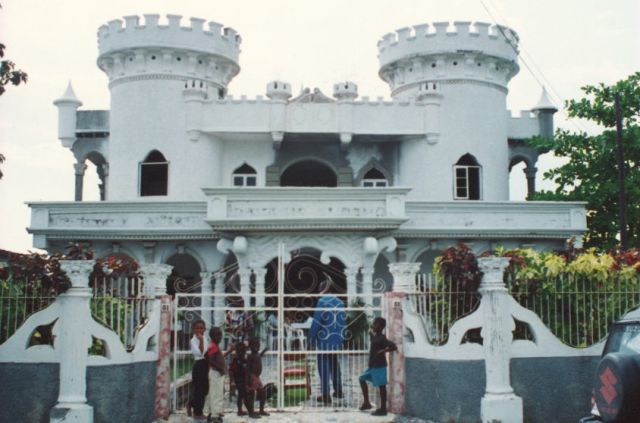 |
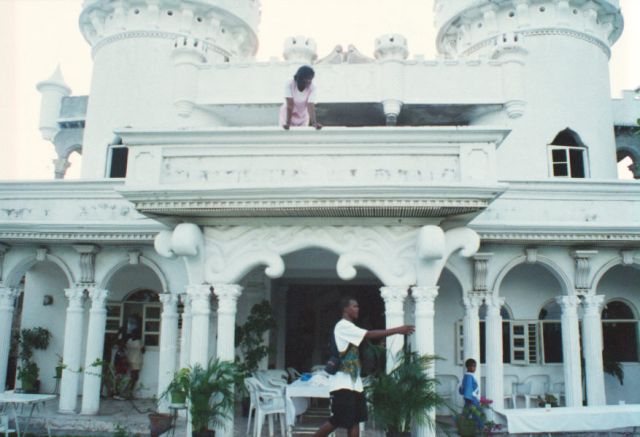
Coming from Spanishtown over the Mandela Highway and driving over the viaduct towards Constant Spring, one can see a shanty town immediately to one’s left. In the middle of it stands a huge concrete monolith, a castellated mansion. Myths have accreted around it like thoughts of chocolate. Most people dismiss it as a Don’s home: a place where a don holds his court, a baron of the underworld most probably launched into power through political patronage. Now that that system is beginning to crumble, the don has become a man who maintains his position by drug trafficking and extreme violence. There is a Mercedes which drives the roads of Kingston with impenetrable glass and number-plates "1Don1". The number plates speak of the risqué appeal of being a don. Such things are heinous to the middle classes, but the middle classes are no longer there in sufficient numbers to be an effective taming force. And so a don is at once a label of virility and power as well as a mythical reality, a baron in the feudal sense, who lives on the myths he encourages to form around him. A don must have his castle. It is that self-evidence that causes most people to assume that this absurdly brazen castle belongs to a don. Others, usually those who have had filtered rumours seeping down to them, know it to be a community centre. Many wonder about it as it presents such a stark contrast, such an ambivalent sign within the shapeless misery of the shanty town. It could be baronial, it could be an act of charity. I sent one of my students to inspect it. Diary, Monday 10th February 1997: On Sunday went with Junior Thompson and Thomas (my son) to the Castle at New Haven: a huge statement in Concrete, a rhetorical tool for every convenience. The man who met us was good-looking and athletic and had the glint of certainty in his eyes. He said he had started building his castle sixteen years ago in troubled times, beginning with a one-roomed wooden shack. Now it is a huge rectangular volume, adjoining a mud track. The façade is divided into three sections with the central portico made of hand-cast columns, with very rough detailing supporting a wild organic and slightly obscene pediment. The tripartite division of the façade is reflected in the plan, which is divided into three equal strokes extending to the back along the longer side of the rectangle like the Dutch Flag. The north side is occupied with a large, long, single space, spanning the entire depth of the house and is used as a karate room. The central nave consists of a recessed entrance foyer/office at the front, a stairwell in the middle and a connecting space between the southern and northern sections. The southern section is occupied by a large kitchen with its peripheral rooms. On the first floor, the rhythm repeats itself except that the space is open and faces out onto a large central terrace above the entrance loggia. The staircase is a wonderful bit of bricolage design, a large spiral without central or perimeter support, made of short pieces of steel they use to reinforce concrete, all welded together into uneven treads. Mr Frances, the good-looking owner of certainty, led us up this fantastic and precarious spiral to the top and most private part of the house where we were given a panoramic view of the neighbourhood. A shanty town flanked us on one side and indifferent concrete housing on the other. The main focus for the roof storey was the meditation room, a room situated at the exact centre of the building with windows all around and the only room that was carpeted. Apart from the meditation copula there was an unfinished pond, set between two square macchiolated and castellated turrets, one of which would eventually become another office. The purpose of the other was not yet clear. The day was organised as a demonstration day for the Karate Club. We had been specially invited. Now the rhetoric and true purpose of the castle was activated. It revealed itself as an emblem for a cryptic and very personal messianic Christianity syncretised with loose fragments of Eastern mysticism. Mr Frances wanted to force evil into submission through karate.... The Castle represented a Christian bastion against a generalised evil. At the same time, and incongruous only to people whose logic gets in the way of things, it was a celebration of his role in that fight. The building of the castle was his way of fighting hardship. It had created for him, in these troubled times, a family bond, a bond made of concrete in Christianity. They had all built the house together. The kitchen, for example, was completely built by his children, he said proudly...and it showed. He went on and on, the karate demonstration became a bombastic sermon on architecture and above all a hysterical celebration of the Lord. Thomas turned to me at one point and confessed he liked his karate “a little less religious.” When the children finally got to show their stuff, it appeared there were two groups from competing schools. The other school had its slogan appropriately aggressive and “eastern”; our New Haven Kung-fu Warlords began their demonstration with a vow of submission to Jesus Christ. Below follows the description of the Francis Castle made by J.P. Thompson and published in AXIS, No. 3 The Francis’home: Hell on earth, heaven in New Haven! [1] A Monograph on 51 Columbus Drive, Kingston 20, Jamaica BY J. P. THOMPSON “Architecture expresses itself nowhere more significantly than in the area of housing. It is here that it touches the lives of every human being and affects their everyday life; the quality of the residential environment, both inside and outside the home, has a profound effect upon the level of satisfaction derived from life as a whole.”[2] In November 1995, I approached the owner Mr Francis. He offered to show me the house the following year saying “I need to do a little fixing out to the interior and some details need to be dressed up, faults, cracks etc. when the interior is more complete, I would be glad to.” After numerous phones calls and visits, I came to know Mr Francis well and I was slowly initiated into the castle’s raison d’être, Mr Francis’ purpose and his family’s mission. Just as the castle had undergone a lot of changes over the past years, the reason for my curiosity also changed as the investigation proceeded. My first reason, as I said earlier, concerned the incongruity of the castle as it is set within the shanty town surroundings of New Haven. What kind of arrogance does it take for a man to build a castle in such a poor area? When eventually I got the opportunity to meet the owners and to enter and experience the inside of the building, I was, at first, also rather disappointed in the quality of the architecture. Most of the columns are slapdash creations, not properly detailed or properly lined up. The ad-hoc combination of different and distinct styles (Classical mixed with Baronial, with Gothic and Islamic arches and Rococo ornaments and windows), all seemed “wrong”. But then, the Francis’ had had no formal training in either architecture, building construction or any other technical field. Despite all this they were themselves the architects and contractors of their own castle. It was then that I realised that I had to change my view of things. At first I thought it would be a good idea to make a comparison between the Francis’ castle in New Haven and Earl Levy’s castle and the New Shopping Centre in Port Antonio, Portland. Although all three are similar in that they are made by the eclectic combination of various architectural styles and techniques, the Francis’ castle was born under very different social circumstances and created with a different purpose. Those are its fundamental characteristics. Therefore to compare the three of them, although interesting, would have shifted the focus away from the castle’s peculiar “mission”. This essay is not to try to evaluate the quality of work done on the castle, nor try to place it in a particular time. Architecture has always evolved from specific circumstances. The aim here is to introduce you to the castle at 51 Columbus Drive, New Haven, to describe it, but more importantly, to explain why and how this remarkable creation came about. In this way the essay will show how the function of a building is often larger than the provision of shelter. It will show how people can use their creativity, resourcefulness and willpower combined with teamwork to achieve their ultimate goal. I will try to demonstrate this by describing the people involved in the Castle’s construction and by recounting the events leading up to its conception. The essay has been put together from interviews with both the Francis’ and residents of the community of New Haven and Riverside Gardens, the Devotion File of the Francis family, a brochure of the New Haven Kung Fu Warlords, and my personal acquaintance of the castle over the past years. There were no original drawings done for the castle because of the way that the design came about. Two years ago, however, the KSAC (The Kingston and St Andrew Corporation) “came down” on the Francis family and demanded construction drawings for the building as it would otherwise have been torn down. Subsequently a set of drawings was done by Mr Poorman. Unfortunately, when Mr Poorman was located, he could not find the drawings. Context and History of Development The building is located in the community of New Haven. New Haven is surrounded by Duhaney Park to the east, the Molynes Mountains to the north, Washington Gardens and Riverton City to the south, and the Riverside Gardens community to the west. The building is located on the border between Riverside Gardens and New Haven. The average income of people within the community is below J$ 3000 per week. Youths within this community lack motivation. Life for most of them is more of a burden than a challenge. Many children and teenagers do not attend school. These can be seen hanging out “pon street corners”. Further west (closer to Six Miles), the community is affected by the even more deteriorated community of Riverside Gardens. Criminal behaviour and the influence from the Riverside community has taken a toll on life in New Haven. Over the past few years there has been a strong increase in violence. The Site The site of the castle was originally owned by a bus owner and was used as an open-air garage. This, as the owner noted, has contributed to the firmness of the soil. “It (the site) was the only yard with compressed marl in the area”, stated Mr Francis. When Mr Francis and his small family (consisting of 6) acquired the land, they used the scraps they found on the site and in the nearby dump, to add to and decorate the existing one bedroom timber house (3.66m X 3.66m or 12' x 12') on the site. They extended the front to form a veranda and built a beautiful picket fence. This was in 1982/3. The layout of the site was very basic. There was a square timber house at the back of the lot, to the left. Behind this house there was a large Basido tree with a workbench placed under it. To the right there was a building, which housed a pit toilet and a shower. Two “Jolly Joseph buses” fronted the smaller building. Later a covered passage was constructed to connect the main house to its services. Subsequently the “Jolly Joseph buses” were taken apart and used to provide two additional rooms. The timber house was then divided into a living and dining room. This fulfilled the Francis’ need for shelter. In February 1987 Mr Francis bought the land to the north of his lot just as the castle’s construction got underway, as the land they had was “too tight.” The construction of the castle was done in phases. First they built the front part of the ground floor. As soon as it was finished the family moved in. After that they demolished the small timber house and the other existing buildings and completed the rest of the ground floor. The design of the castle evolved as it was being built. The castle, Mr Francis admits, was never designed. He attributed the idea of the columns and towers to his wife’s ingenuity, with some input from his son and himself. The exotic towers were copied from books and magazines and buildings in Jamaica they had seen. In an article in the Sunday Herald, Mr Francis commented: “In the case of building pillars and marble sculptures, the family simply bought one of each and then used them as models to construct as many as they needed”[3 They wanted to do everything themselves. “When we were not aware of how to do something we would call in the ‘expert’ and learn what he does so that when the next time comes, we can do it ourselves”. As such the family rented a tile cutting machine and, having learnt from observation, would cut, lay and polish their own tiles. “Experts” also laid out the electricity for the ground floor. However, when they were ready to do the upper floors, they wired the panel boxes themselves. All this gave them a sense of achievement, but most importantly, helped them to save money. The Building as an object The castle is rectangular in plan and oriented along an east-west axis. The main entrance faces east. The rectangular block is sub-divided along its length into three aisles, which themselves are divided into six irregular bays. The front of the house has an elaborate loggia. The main entry on the central nave is recessed and leads through an office to a centrally placed spiral staircase, delaying the division between the inside and the outside. This can be seen on the plan. Because of the way the paths lead up to the building it is difficult to get a proper frontal view. The oblique approach enhances the effect of perspective on the building’s volume and makes it come alive. The principal identifying characteristics of the castle’s form are the result of a specific configuration of surfaces and edges. The castle is basically rectangular in volume. Over the years it has been transformed by the addition of two cylindrical, crenelated towers on the eastern facade, a dome and a smaller crenelated cube placed on top, which helps to define the skyline of the whole neighbourhood, making it a landmark for miles around. The castle has three levels. The ground floor is the most public of the three. It has an arcaded, cross-shaped, veranda, covered by the balcony above. To the south there is a generous kitchen, a dining area and a guestroom. The dojo room (training room), the largest room in the entire building, takes up the entire length of the northern side of the ground floor. The first floor consists of a large living area, opening out onto a large balcony at the front, which together take up a little less than half the total floor area. On the north side there is a master bedroom with its master bathroom and on the southern side there are two regular bedrooms sharing a bathroom between them. The Roof is the most private of the three levels, it has a square meditation room which is on the west side of the building, housed in the crenelated cube, a small unfinished pond between the two cylindrical towers. These towers overlook the entrance gate and are decorated with corbelled crenelations. All levels are accessible via a spiral staircase made entirely of short pieces of individually welded steel and located at the exact centre of the building. This staircase seems to be floating through space as it ascends into the air, punctuated only by the floors it touches, supported on the exterior rail, rather than the usual central pole. Engineers he consulted rejected his proposal of building the stair without a centre post. Mr Francis commented “they all said it cawn work, I being not as technical as they were, decide that I would attempt it myself since none of them wanted to attempt it.” This he did, successfully. “Because I didn’t possess the necessary machinery to bend the steel to achieve the required curve, I had to cut and join. This make the work look sloppy but in the future I will try and get that rectify, the stairs would be eventually capped with wood.” Mr Francis added. There are many occasions where the family’s creativity and innovativeness has led to a reduction in the amount and cost of construction. The construction technique used to manufacture the many columns is yet another example. There are three types of columns, all of them fruits of “trial and error”. Mr Francis explained that the first set of columns was cast in the round. His eldest son Cleveland used a mop stick to mould the flutes in the columns. The second type was cast in a mould made of fibreglass, which worked slightly better, but still left a lot to be desired. The third type was first cast in the round as the first lot and then “flash-fluted” using a freehand technique. This gave a better result. A row of the best-fluted columns was used for the loggia on the front façade. This semi-transparent screen is made up of a free-form classical arcade supported on double columns, which is crowned by a plain but deeply profiled architrave. The central bay is wider than the others and projects forward. Instead of a classical arch punctuated by a central keystone, the columns support a wild and fantastic accolade. The large balcony on the first floor wraps around the north and south facades transforming into long and narrow colonnaded corridors running from east to west. The castle has a rigid skeleton frame, with beams, columns and 6" blockwork infills. There were originally 7 beams (equally spaced at 10'-0" centre to centre) running the width of the building. When the towers were introduced, an 8th beam had to be incorporated into the design to support them. This new beam can be seen on the plan. The walls are made of 6" concrete blocks and breather blocks. The exterior walls were coarsely rendered while the interior walls are smooth or clad with timber. The floors are made of Hellshire marble, bought in Rockfort. The ceiling beams are rendered and the dominant colour on the interior is bone white. Apart from considerable amounts of timber, other building materials include fibreglass, which was used for the light dome covering the central staircase as well as the onion-shaped baldachins over the windows on the west elevation of the first floor. The economic constraints faced by the family “dragged out” the construction period. Materials and other necessities were had only when money was available, which was rarely. As a result the construction costs of the castle would be almost impossible to calculate. Even so, because of the creativity of the Francis’ and the fact that they did not have to pay for labour or many professional services, the cost was kept to a minimum. As it stands now the castle has never been destroyed, rebuilt, or restored. However over the years the plans have changed considerably and numerous additions have been made. Changes to the exterior were largely for aesthetic reasons. Because of the castle’s purpose, the look of the castle was very important. This is acknowledged implicitly, by the fact that the exterior is far more complete relative to the interior. When asked what influenced the form of the building, Mr Francis pointed out that there were two main factors that affected the building’s form. The first includes the many problems that occurred during construction and the second is Mr Francis’ strong Christian background. All the members of the Francis family are practising Christians. Mr Francis declares that “self expression” is his concept of Christianity. “The form is linked to the purpose, ‘ESCHATOLOGICAL’, that is, the things that has an eternal consequence,” The people involved It is unlikely that anyone who has seen ”The Castle in New Haven” has failed to form an opinion about it. It is equally unlikely that that opinion be a good one without the person first knowing the reason for which it was created. To appreciate this building, which seems so out of its context, it is essential that the process leading up to its construction be understood. This building is a creation of the mind struggling with the world. The persons involved in its construction, the Francis Family, came together 16 years ago in an unusual way. The Francis Family consists of Mr Ralston Francis, husband of Mrs Hyacinth Francis, and adopted father of her four (4) children; Vivien Stephenson (b1968), Cleveland Francis (b1972), Nicola Francis (b1975), and Leo Francis (b1977). Ralston Francis, a young man who had grown up in the church, had begun to wander from the path because of his dissatisfaction with the institution. “At that time in my life I rebelled against religion, and became almost like an Atheist.” He became, in his own words, “a girl-chasing animal, living only for the pleasures of the world.” He had become so caught up with “vanities and earthly possessions” that he had forgotten about the one who gave him all these things. He realised that when he chased these things of the world, such as sex, he would at first enjoy it. But soon afterwards he would suffer “hang-overs.” On most weekends he would drive up to the North Coast with a car filled with girls, rent a hotel, have a “grand time”, and then return to Kingston. He would use most or all of his salary during these trips and would barely have enough money to last him until the next pay day, after which the cycle would begin again. At one point in his life he was living in a ten-bedroom house in Red Hills, with a very wealthy “white woman”, from whom he had originally rented a small room. She wanted him to marry her, but he refused. “I felt that I would be obligated to whatever she say, I my friends would be saying that me only marry her for her money” She subsequently asked him to leave, which he did. He returned to the small room he had rented, which he had not used for months. That night Mr Francis spoke to God for the first time in many years. “Me just lay back an’ reason with him...not a prayer, just reasoning. Me say: God look like me haffi try it your way ‘caw mine naw work”. He packed up his stuff and went to see a friend of his, who owned a carpenter’s shop. The owner of the shop wasn’t there. Instead he came across Hyacinth, who had promised the owner of the shop that she would come and pray for his workers. It was there that Ralston Francis and Hyacinth met. She spoke of her life, of where she was living with the children and how the landlord had evicted her because she had refused to go to bed with him, how she went to jail because of the said landlord, how she had to “kotch” at friends as she did not have anywhere to go; how she had to leave the children in the country, under the care of her mother. She also told him that throughout all of these “trials and tribulations” she had never given up her trust in God. Mr Francis said “God assured her that if she put her trust in Him she would be rewarded abundantly.” In “Jerusalem” (the name Hyacinth used for the house she was evicted from) Hyacinth had a vision. Mr Francis said “in a vision that Hyacinth got, God said he was going to give her a castle. Bless her and make her a queen.” That was how they had the idea of building the castle. The castle was born of a vision. Mr Francis and Hyacinth became friends. He saw her as his queen. He adopted her children as his own. Over the years the Francis family were frequently tested in “their faith, by God.” With every battle won, another would present itself. These “continuous trials and tribulations “ Mr Francis added “brought the family closer together, and strengthened their spirit.” The battle to prove their faith in God became an everyday part of their life. “God,” he said “put us under pressure to get strengthened”. There were moments when he felt that he had had enough. “But when I spoke to the children and asked them; suppose I decided to call it a day?” they argued that to give up now would be like destroying what they (the family) had tried so desperately to create over the past years. From the beginning when the Francis’ came together as a family, they worshipped together “every morning.” Mr Francis started to record things that took place during the devotions and in their lives over the years. This became their Devotional File. They would use this to look back at their life. He tried as much as possible to keep this file up-to-date, to compare their past with their present. In one instance he gave the children an assignment, which was to write about a past experience. Both Nicola’s and Leo’s response are included as appendices to the article. According to Mr Francis, their family bond is a direct result of the years of hardship. Whenever anyone member of the family was faced with any difficulty, they would always have a foundation to go back to. They always did things together as a family. They would read the scriptures about people like Paul and Silas, and many others, who went through the same test of faith that they did. “These people put their trust in the Lord God and overcame whatever misfortunes meted out to them. They served as examples to us and gave us the courage and will power to move on.” Cleveland, the eldest son, started to training in the Martial arts and soon everyone in the family started to participate. The largest room in the building was where they would do their training. Eventually these training sessions were opened to the children of the community. This led to the formation of what is now “The New Haven Kung Fu Warlords,”- a non-profit, leisure-time organisation, that seeks to train residents in the Martial arts. Originally the organisation was a way of getting the youths of the community to divert their energy into something worthwhile. Mr Francis noticed that it could be used to “bring the participants closer to God,” in that it would help them to practice control, patience, loyalty and obedience, which are the important characteristics of a Christian. They use the physical training to attract the youths and then, once they are in, they receive spiritual training. Christianity has therefore played a vital role in the life of the Warlords, as can be seen in The Warlords’ pledge. “As the world races towards the end of the twentieth century, the battle between good and evil is becoming more intense. The increase of domestic disputes, crime and violence, greed, selfishness and environmental abuse, reveal the extent of Satan’s control especially among our youths. This condition is forcing many to arm themselves with weapons of destruction, to defend themselves against physical and verbal abuse. Deep within our culture is the traditional use of evil spirits (Obeah) for selfish and destructive purposes.” “The Kung Fu Warlord Programme is based on the premise that, spiritually, man must submit to the rulership of God and become a soldier in the army of love, fighting against the forces of evil. Mentally, he must cultivate pure thoughts by deep meditation on divine principles, shutting out the evil-inspired thoughts. Physically, through regular exercise and the application of various fighting styles of Karate and Kung Fu, the body becomes the Temple of the Living God and a weapon against offence, injustice, and oppression.”[4] At one point it was rumoured that Mr Francis was a “druggist” who had run away from The States and was building himself a hideout. When this rumour was shown to be false, people instead accused his wife of robbing Edith Dalton James of the money, using the school’s bursary to help build the house. Mrs. Francis went to jail for a second time, again because of a false accusation. The case was eventually thrown out due to lack of evidence. Mr Francis assured me that the financing for the construction of the castle came from out of his own earnings. “I would do masonry work then use the money I earned to buy materials, which we would use.” Mr Francis said he had a vision once where he asked the lord what the castle was to be like, “God said ‘It shall be like the Ark’ (Noah’s Ark).” At first Mr Francis misinterpreted this and thought that the building was to have the physical properties of the Ark i.e. that it was to be like a ship, with a broad base and then stepping back as you go up. He also recalled that the Ark had three levels, this is also represented in the castle having three levels. He then realised that the Lord was not talking about the physical structure of the Ark but about its purpose and what it was to used for. “The Ark was a rescue ship for God’s People,” Mr Francis said that this was what encouraged him and his family to make the castle accessible, as much as possible, to the whole community. The castle has the same purpose as Noah’s Ark. It is serving the community as a place of refuge from the war and hatred all around them. Mr Francis said that he and his family looked a lot at ancient structures to generate the “proper” form. “If I could bring a physical expression of the ancient monarchies of God, then that would help to bring clarity to my mission” Mr Francis considers himself to be on a personal mission for God. As such the building was built to fulfil a number of functions. To bind the family, but also to give the people of the community “a little more pride,” and show the people of the community that they can unite and do things together and for themselves. One special hope that Mr Francis cherishes is that the building will become a catalyst, which will help to make his community a model for the year 2000. What do others think? When asked why in New Haven, and why this “eye-catching design” as Dwayne Gordon described it in The Herald, Mr Francis commented: “People are always moving away from depressed areas when they become rich or they can afford to” He strongly opposes this and believes that this is wrong. Mr Francis feels that the people within the community should always try to maximise their resources no matter what. “To pretty up, that is the idea. Have a little more pride.” He envisions himself as “a man with a mission”. The purpose of this building is to uplift the community, both physically and spiritually. In fact it can be shown that the building has indeed started to do so. “Other people have started to pretty up, some even try mimicing elements off it” said a happy Mr Francis. Most of the people that I have spoken to, particularly those who live in and around the community, said that if they had the money they would never have built such a “pretty” building in that slum. One young lady exclaimed: “House like dat shouldn’t be dun deh soh (New Haven)! ...it look too odd…it should a deh pon di hills (Jacks Hill, Beverley Hills, Cherry Gardens, etc.)”. Another young lady, probably the same age as the first, who once lived in the community and who comes back there on weekends to visit friends and family, stated: ”Me wouldn’t build my house dun yah if me get rich...fi wah? yuh mad?” Although this appears to be the general consensus, people still appreciate the building in their midst. The building has become more than just the home of the Francis’. It has become the heart of the community. Nearly everyone within the community uses it from time to time, either to participate in community functions held there or to attend training sessions with the Kung Fu Warlords. It has become a refuge for the many young people in and around the community: “when a small positive is injected in what is negative then there possibly can be some change.”[5] USES At present the building is the home of the Francis Family. However, the building also serves as the headquarters for a number of other different groups. These include: The New Haven / Riverside- Community Provident Society The New Haven / Riverside- Citizens’ Association The New Haven / Riverside- Research and Development Trust The New Haven / Riverside- Kung Fu Warlords These are all registered under the company act. The building also houses Mr Francis’ private business, Shammar Industries Co. Ltd., which is owned and operated by the family. A final word If you are of the opinion that this monograph was irrelevant to us, I suggest that you take a boat and sail across the ocean and get yourself shipwrecked. Only then will you realise what this essay was actually about. Bibliography The Francis Devotion Material file The brochure of the New Haven Kung Fu Warlords [1] Gordon Dwayne, “In the Castle of a Family” The Sunday Herald, Jamaica, February 18, 1996 [2] Housing Design in practice, by Ian Colquhoun & Peter G. Fauset, copyright 1991, page x [3] Article in the Sunday Herald, February 18, 1996, pp 5A [4] First two paragraphs of the New Haven Kung Fu Warlords Philosophy. [5] Article in the Sunday Herald, February 18, 1996, pp 5A |
||
 |
|||
Contact me at: jacob@voorthuis.net
copyright © jacob voorthuis 1994-2011
All written material on this page is copyrighted.
Please cite Jacob Voorthuis as the author and Voorthuis.net as the publisher.