Barracks
|
|||
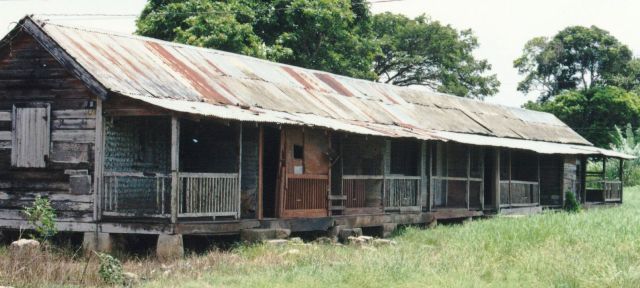 |
“As soon as he saw the barracks Mr. Biswas decided that the time had come for him to build his own house, by whatever means. The barracks gave one room to one family, and sheltered twelve families in one long room divided into twelve, This long room was built of wood and stood on low concrete pillars. (…) The corrugated iron roof projected on one side to make a long gallery, divided by rough partitions into twelve kitchen spaces, so open so that when it rained hard twelve cooks had to take twelve coal pots into twelve rooms. The ten middle rooms each had a front door and a back window. The rooms at the end had a front door, a back window and a side window. Mr Biswas, as a driver, was given an end room. The back window had been nailed shut by the previous tenant and plastered over with newspaper. It position could only be guessed at, since newspaper covered the walls from top to bottom. This had obviously been the work of a literate. No sheet was placed upside down. (…) p. 206. when neither food nor tobacco tasted , and he could only lie on the four-poster and read the newspapers on the wall. He soon had many of the stories by heart. And the first line of one story, in breathless capitals, came to possess his mind: AMAZING SCENES WERE WITNESSED YESTERDAY WHEN. (…) the words came into his head and repeated themselves until they were meaningless and irritating and he longed to drive them away. He wrote the words on packets of Anchor cigarettes and boxes of Comet matches. And, to fight this exhausting vacancy that left him with the feeling that he had drunk gallons of stale, lukewarm water, he took to lettering religious tags on strips of cardboard, which he hung on the walls against the newspapers. From a Hindi magazine he copied a sentence which, on cardboard, stretched right across one wall, above the papered window: HE WHO BELIEVETH IN ME OF HIM I WILL NEVER LOSE HOLD AND HE SHALL NEVER LOSE HOLD OF ME. V.S. Naipaul A House for Mr. Biswas, p. 211.
|
||
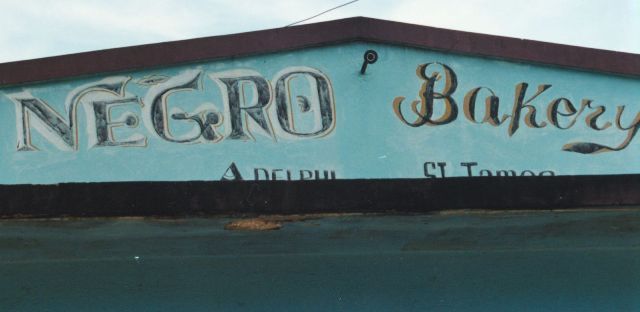
| A similar barracks in Jamaica I came accross in the middle of nowhere, somewhere in Westmoreland or St James. On the same trip I came across the picture below which speaks for itself | |||
 |
|||
Contact me at: jacob@voorthuis.net
copyright © jacob voorthuis 1994-2011
All written material on this page is copyrighted.
Please cite Jacob Voorthuis as the author and Voorthuis.net as the publisher.